
Resources
Commercial restroom cleaning checklist: each visit, weekly, deep work and restocking
A restroom is judged in seconds, so its list runs longer than any other room’s. Here are the tasks by cadence, the supplies to restock, and a printable sheet for checking restrooms in Antioch and Pittsburg.
Printable checklist
Why the restroom gets a list of its own
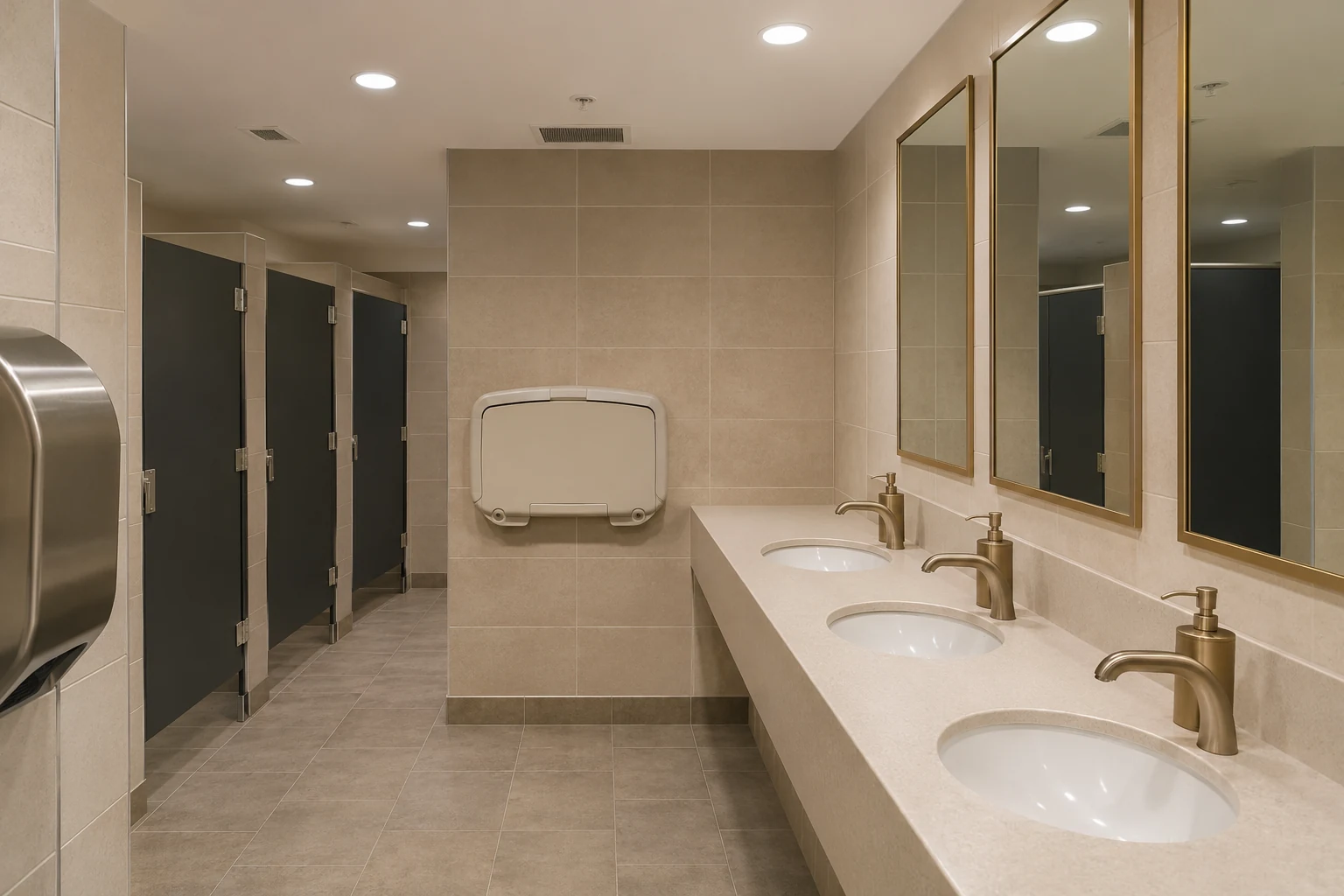
Offices, stores and warehouses share one thing: the restroom is where a skipped task shows first. An empty towel holder or a dull floor near the urinals gets noticed by staff and visitors alike, which is why we keep restroom tasks on their own sheet instead of burying them in a building-wide list.
The checklist below splits the work into each visit, weekly and periodic deep work, with restocking as a group of its own. It suits a two-stall office restroom as well as a public restroom with a row of fixtures. A busier room simply moves tasks up a column.
The sheet earns its keep at three moments: when service is being set up and you are deciding what each restroom needs, during the first weeks while the routine settles, and any time a complaint comes in. In each case it turns a general sense that the restroom looks tired into a specific line that someone can act on that night.
Each visit
These tasks keep a restroom ready from one day to the next, and on recurring service they run every time the crew is in the building.
- Clean toilet bowls, seats, urinals and the outside of each fixture
- Clean sinks, faucets and the counter around them
- Wipe mirrors and any glass at the hand-washing stations
- Wipe flush handles, faucet levers, door pulls, stall latches and dispenser fronts
- Empty trash and sanitary bins and fit new liners
- Sweep and mop the floor, working into corners and around fixture bases
- Spot-clean marks on stall partitions and the walls near the sinks
Once the surfaces are clean, EPA-registered disinfectants go on the fixtures and touchpoints and remain on the surface for the full dwell time their label lists.
Restocking
Restocking is a supplies job, and it happens on the same visit. Open each dispenser rather than judging it from outside, since a holder can look full with one roll left inside.
- Toilet paper in every stall
- Paper towels at each sink or towel station
- Can liners in every bin
- Hand soap in each dispenser
- Hand sanitizer at the stations that have one
- Toilet seat covers in each stall
We can supply all six through our janitorial supplies service and mount matching dispensers, or refill from the stock you buy yourself. Either way, the crew tops up every holder before leaving.
Weekly
Weekly work deals with what gathers slowly and is easy to miss on a quick pass: film on partitions, dust on high edges, scale around faucets and grime in the corners.
Put these on a set night so they do not slide. In a building with several restrooms, the crew can rotate them, giving one or two rooms their weekly detail each night so the extra time spreads across the week.
- Wash stall partitions and doors on both sides
- Wipe the tops of partitions, mirrors and dispensers
- Detail-brush the cove tile and the corners behind the door
- Clear floor drain grates and run them through with clean water
- Remove fresh scale from faucet aerators and from toilet and urinal rims
- Wipe the wall around hand dryers and towel stations
- Clean the entry door and its kick plate on both faces
Periodic deep work
Some soil sits beyond a mop and a cloth. Grout darkens a shade at a time, scale crusts at the base of fixtures, and glazed wall tile loses its shine. Our restroom deep cleaning handles that on its own calendar, every month or every quarter, matched to the room’s traffic.
- Machine-scrub the floor tile and its grout lines
- Lift built-up scale from bowls, urinals and basins
- Wash glazed wall tile from the top edge down to the cove
- Dust exhaust grilles, light covers and high ledges
- Detail every dispenser, hand dryer and piece of fixture chrome
- Hand-scrub baseboards where a machine cannot reach
Using the sheet on a restroom check
Check a restroom at the hour people use it most, not right after a visit. Mid-morning and just after lunch show whether the each-visit work holds up and whether the supplies last through the day.
Mark any line that keeps failing, and post a restroom cleaning log by the door so every check between visits gets a time and initials. If paper runs out by afternoon every day, the answer is a larger holder, an extra refill round from a day porter, or both. If the floor near the urinals smells by Thursday, the weekly drain and corner work needs a closer look, and our supervisors’ quality inspections can confirm what is being missed.
Warehouse and production sites have their own timing around shift changes, which our guide to cleaning support spaces between shifts covers. For recurring service that includes this list, see our janitorial services in Antioch or call (925) 528-0380.
A few useful answers
Common questions
How many times a week does a commercial restroom need cleaning?
Once for every day the building is open, at minimum. Busy public restrooms often add a daytime check from a porter, and deep work follows traffic, monthly or quarterly.
What belongs on a restroom restocking list?
Toilet paper, paper towels, can liners, hand soap, hand sanitizer and toilet seat covers. Opening each dispenser on every visit keeps them from running out.
What is the difference between restroom cleaning and a restroom deep clean?
Recurring cleaning keeps fixtures, touchpoints and floors clean between visits. A deep clean is a separate visit that goes after grout, built-up scale and wall tile.
Where does a stubborn restroom odor come from?
Odor usually comes from residue in floor drains, soil packed into grout and the film in front of urinals. Weekly drain work and periodic floor scrubbing remove the source.
Is the restroom checklist free to print?
Yes. Download the PDF from this page and print as many copies as you need for each restroom.
Resources